The State, Civil Society and The Tentacles of Collective Violence in Bangladesh
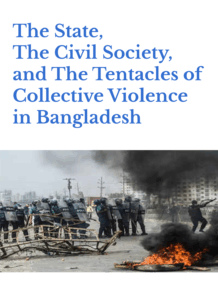
In 2021, Syed Jamil Ahmed conducted evidence-based research by employing qualitative as well as quantitative methods in attempting to understand how, if at all, collective violence in Bangladesh has seeped so deep in the social fabric that both the state and the civil society operate as its appendages, often working in collusion with each other. The quantitative data is based mostly on all newspaper reports on violence as published in 8 national dailies and 10 regional dailies in Bangladesh from 1 January 2012 to 31 December 2021, as available in Bangladesh Peace Observatory database maintained by Centre for Genocide Studies (CGS). Some data have also been collected from Ain O Salish Kendra (ASK) publications. Qualitative data in the form of micronarratives, was gathered by the Centre for Genocide Studies, from various individuals representing a cross-section of the people from Gazipur, Rajshahi, Chapai Nawabganj, Chittagong and Khagrachari administrative districts in Bangladesh. A monograph, based on the research is expected to be published soon by the Centre of Genocide Studies, University of Dhaka. The monograph proceeds in three chapters. Chapter One examines quantitative data on collective violence in Bangladesh from 2012 to 2021. Chapter Two examines micronarratives from 2016, and Chapter Three from 2018. The Conclusion sums up the findings and argues that the hypothesis stated at the beginning is indeed a valid thesis. This slim volume has been possible because of CGS-UNDP Fellowship on Peace, awarded to Syed Jamil Ahmed in 2021.